

Parenting is hard work, and doing it with an ex can feel even harder. Your values and upbringing shape how you raise your child, and those won’t always line up with your former partner’s. If you’re a dad who’s struggling to make co-parenting work, counseling may help.
Co-parenting is a term that fits many relationships. Though often used to describe divorced parents, this term also applies to parents who have never been married. If you and your partner are no longer together, co-parenting may be the best method to raise your child. Your priority is your child, and research shows that a child benefits from having both their mother and father in their life (5, 6).
“Unless your family has faced serious issues such as domestic violence or substance abuse, co-parenting—having both parents play an active role in their children’s daily lives—is the best way to ensure that all your kids’ needs are met and enable them to retain close relationships with both parents.” (1)
As a dad, your role is to make sure your child’s needs are met, whether through child support, joint custody, or both. That starts with creating a stable, supportive environment, even when you and your child’s mother live apart.
Is your girlfriend pregnant?
Need some guidance?
It takes a village.
Check out this article:
Creating a good relationship with your child’s mother may not be an easy task. Joint custody can be stressful, angering, and exhausting. Sometimes it may feel difficult to find common ground, especially if the relationship ended poorly. However, maintaining a positive relationship is important, for the sake of your child. A good place to start is a parenting plan you both agree on.
Of course, there will likely be aspects of your parenting plan that you and your ex don’t agree on. When you are not seeing eye to eye, take a step back. Creating a parenting plan keeps everyone on the same page. Here are a few things to keep in mind as you create your plan:
- Consider your child’s best interests as the primary goal. Every kid is unique and each stage of life is different. Understanding your child’s needs helps you decide what kind of child custody will work best for your child.
- Create a flexible parenting schedule that works for your family. This will help ease your child’s transition between separate homes and lifestyles.
- Go over your child support requirements. Child support requirements may be decided by a court order. Open communication will ensure you are on the same page when it comes to financial requirements.
- Remember this is not a win-lose situation. These decisions must be made in the best interest of the child (2). When your child is safe and well-adjusted, everyone wins.
These are important pieces to consider when making your parenting plan. Remember that different phases of life come with different challenges, so your parenting plan may have to adjust to fit.


A positive relationship between parents is one of the most important things in a child’s life. Your child sees everything. They are an astute observer and can detect a high-conflict atmosphere. So it is important that you and your ex are diligent in maintaining a positive relationship. Here are some tips:
- Set aside your negative emotions. Let them go. Holding on to them will only hinder your relationship with your ex, which will affect your child. Make it a point not to argue in front of your child, or they will begin to feel as though they are in the middle of your conflict (1).
- Cultivate healthy communication skills. Never use your child as a messenger. If you need to communicate with your ex, do so in an effective, polite way. Creating a business-like relationship can help set the standard of communication between you. This will help create a safe space where you can discuss the needs of your child without involving them (1).
- Learn conflict resolution skills. These skills include respect, learning to let the small stuff go, and compromise. These aren’t easy to learn, but they are important in maintaining a positive relationship.


What Is Co-Parenting Counseling?
Co-parenting counseling brings you and your child’s mother together with a trained counselor, therapist, or mediator. The goal isn’t to repair your romantic relationship. It’s to help you work together as parents. A counselor can help you communicate more calmly, work through disagreements, and build or update a parenting plan that puts your child first.
Sessions may be held together or separately, in person or online, depending on what works for your family and how much conflict there is. In some cases, a family court may order co-parenting counseling as part of a custody arrangement. Even a few sessions can make a real difference in how you handle the challenges ahead.
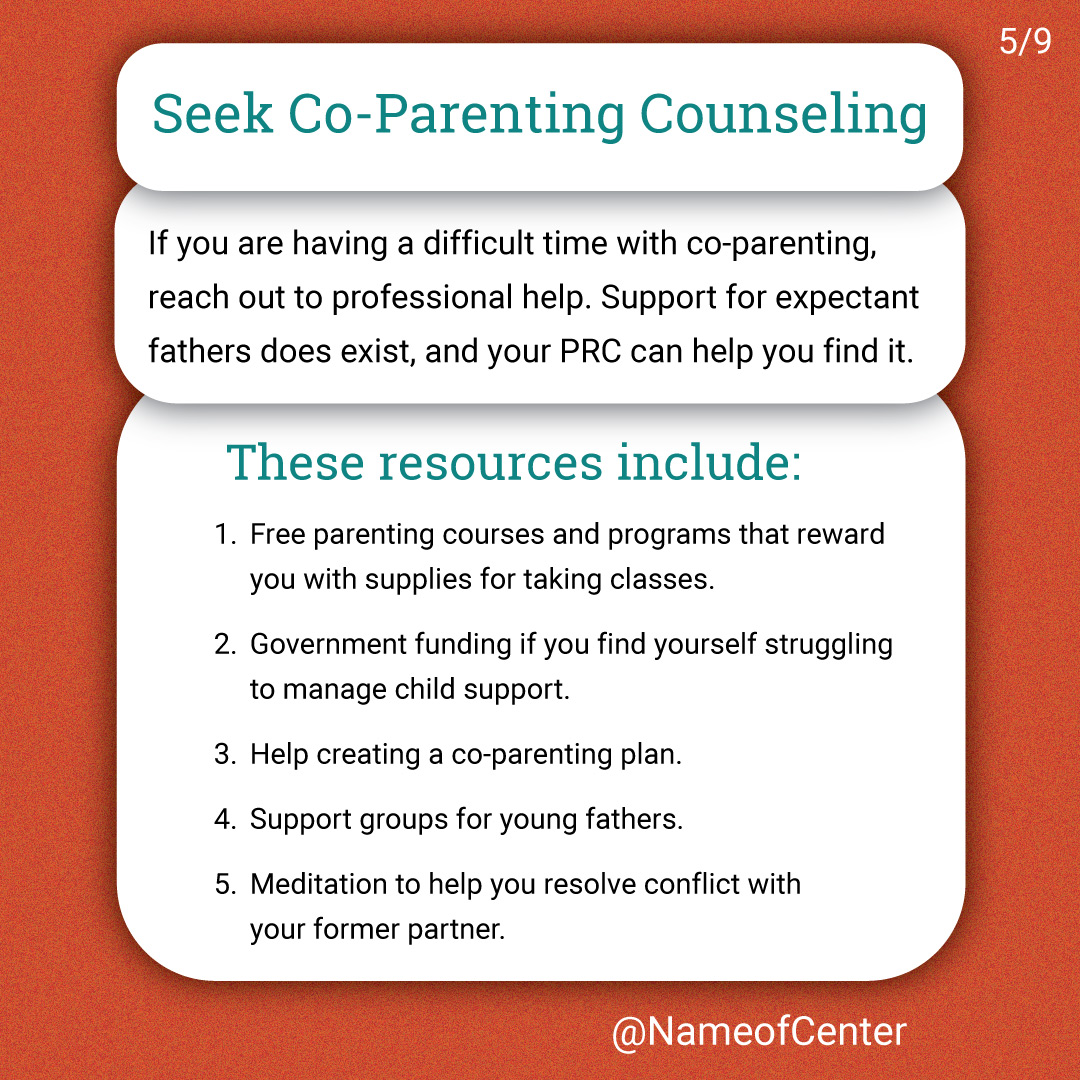
If you are having a difficult time with co-parenting, reach out for professional help. There are plenty of resources available for you to use.
One of these resources is your local Pregnancy Resource Center (PRC). There, you can find all kinds of support that will help you navigate this difficult time. Support for expectant fathers does exist, and your PRC can help you find it. These resources include:
- Free parenting courses and programs that reward you with supplies for taking classes.
- Referrals to government assistance programs if you find yourself struggling to manage child support.
- Help creating a co-parenting plan.
- Support groups for young fathers. These are useful if you’d like to find other people who are experiencing similar situations.
- Mediation to help you resolve conflict with your former partner.
The importance of support from friends and family cannot be overstated. Reach out to those in your support circle for help creating a plan and maintaining your relationships.
Haven’t told your parents about your girlfriend’s pregnancy?
Check out our article for tips on breaking the news.
One major factor in co-parenting is child support.
Who pays child support?
Child support is a requirement of the non-custodial parent, who tends to be the father. If the parents opt for joint custody, the court decides how much each parent is required to pay (3).
What are child support rates based on?
The court considers a couple of different factors when deciding child support rates. Typically, they account for the child’s specific needs, resources available, and each parent’s ability to pay (3).
How do I change child support payments?
Child support rates aren’t easy to change. If you need to modify payments, you need to file a request with the court. Only the court can change the rates, but if both parents agree on the change, it’s usually a fairly quick process (3).
What happens if I miss a payment?
It’s important to keep up with your child support payments. If you fall behind on payments, the courts will become involved. This can result in consequences like jail time, seizure of property, suspension of your driver’s license, and more (3).


If you’re having a hard time making your child support payments, there are groups like the United Way that can get you in touch with pro bono legal support. These organizations can help you get the paperwork you need and may be able to offer you legal support as well (4). Contact your local PRC to get in touch with some of these resources. You can also examine your lifestyle, make a budget, and reduce your expenses. Your local PRC can offer you help with budgeting as well.
Need Help with Child Support?
We have resources for you.
NAME OF CENTER
You need to be involved in your child’s life. Parent-child relationships are some of the most important relationships we carry with us. If you are co-parenting, you need to commit to consistent communication with your former partner. A positive relationship will ensure your child grows up feeling as loved and supported as possible. That way, everybody wins.
Sources
- Block, Jocelyn and Melinda Smith. (2026, February 18). Co-Parenting and Joint Custody Tips for Divorced Parents. HelpGuide.
https://www.helpguide.org/family/parenting/co-parenting-tips-for-divorced-parents - Creating a Perfect Parenting Plan in 6 Steps. (2017, June 8). OurFamilyWizard.
https://www.ourfamilywizard.com/blog/creating-perfect-parenting-plan-6-steps - Fay, Bill. (2025, April 7). Child Support. Debt.org.
https://www.debt.org/family/child-support/ - Fay, Bill. (2026, February 5). What To Do When You Can’t Afford Child Support Payments. Debt.org.
https://www.debt.org/family/child-support/cant-pay-child-support/ - Bauserman, Robert. (2002). Child Adjustment in Joint-Custody Versus Sole-Custody Arrangements: A Meta-Analytic Review. Journal of Family Psychology, 16(1), 91–102.
https://doi.org/10.1037/0893-3200.16.1.91 - Nielsen, Linda. (2018). Joint Versus Sole Physical Custody: Outcomes for Children Independent of Family Income or Parental Conflict. Journal of Child Custody.
https://doi.org/10.1080/15379418.2017.1422414